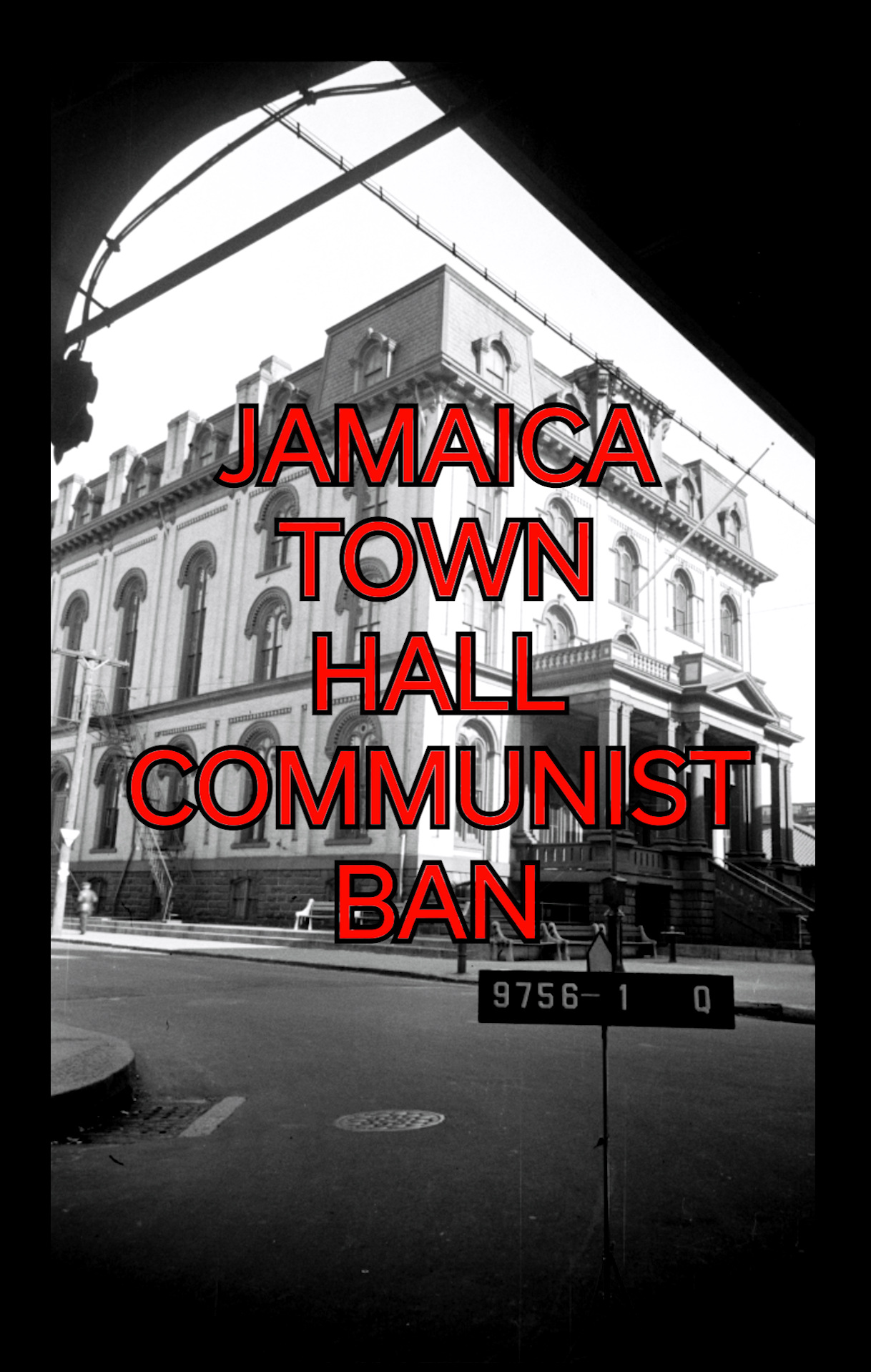
Jamaica Town Hall Communist Ban
(script)
INTRO
Queens during the Great Depression was a hothouse of constitutional debate.
On Jamaica Avenue, in the last days of a trolley and an elevated train, there still stood a Jamaica Town Hall at the corner of Parsons Boulevard, now the site of a McDonald’s and a health clinic. In the 30s it was the centerpeice of Queens’ culture clash, as the Communist movement peaked in America.
In the spring of 1936, the Jamaica branch of the American League Against War and Fascism applied to use the Town Hall. But Republican Borough President George Harvey denied the permit, citing Communist involvement in the organization.
Fall ‘36
In the fall, congressional candidate Paul Crosbie, chair of the Queens Communist Party, applied to use the town hall for a rally.
Again, Harvey denied the permit. He said: “No party seeking overthrow of the American Government will be given the use of Queens public buildings so long as it remains in my power to stop it.”
The Civil Liberties Union said: “The question at stake is the right of one man to say who shall or shall not have the right to use the public buildings in Queens.”
Harvey found support among veterans groups and the Queens GOP. But Crosbie found allies in the Queens Democratic Party, the Queens Fusion Party, the Queens Socialist Party and the American Labor Party.
PROTESTS
The Communists protested Harvey at 46th Street and Greenpoint Avenue in Sunnyside, where a divided crowd of 100 assembled, and someone chucked a tomato at Crosbie.
They protested at the Bohemian Town Hall, where 350 showed.
Writ of Mandamus
A lawyer for the Communists drafted a writ of mandamus to force Harvey to open the Town Hall doors, but Justice Paul Bonynge sided with Harvey. He said, “A justice of the court is required to take an oath to support and defend the Constituion… the Communist Party avows its purpose to overthrow the Constitution….”
Crosbie replied: “From what source did the learned judge discover that we proposed to overthrow the Constitution which his verdict so grossly outrages?”
FAITH LEADERS
A delegation of faith-based leaders appealed to Harvey in protest.
They represented: the St. James Episcopal Church in Elmhurst, the Congregation Beth-El synogague of Astoria, the Van Wyck Congregational Church of Jamaica, the Union Church of Corona, the Temple Gates of Prayer of Flushing and the Hollis Unitarian Church.
SOCIALIST RALLY
The Socialist Party invited the Communists to speak at their rally at the Jamaica Town Hall. One of them said: “We disagree with the Communists—for reasons entirely different from those of Hitler Harvey. But the right of free speech and free assemblage is of much greater immediate importance than those of differences.”
SUPREME COURT
For the third time, the Communists took the case to the Queens Supreme Court, where an ACLU lawyer argued: “Assuming that the Communists did advocate force and violence, should they be denied the right to meet? What they believe does not make any difference.”
But Harvey’s attorney said the borough president would be “subject to a fine for a misdemeanor under the penal code if he allowed a group of people to meet for the purpose of overthrowing the government.”
On October 10, Justice Faber said: “On this statement of facts, it cannot be said that the Borough President, in acting on his own honest and sincere and uncorrected understanding of the possible motive, purpose or intent of this rally and in that conviction denying the permit, can be held to have acted in any arbitrary and unreasonable exercise of his discretion, and this consideration compels denial of the mandamus order.”
Epilogue
Five years later, the town hall was destroyed.