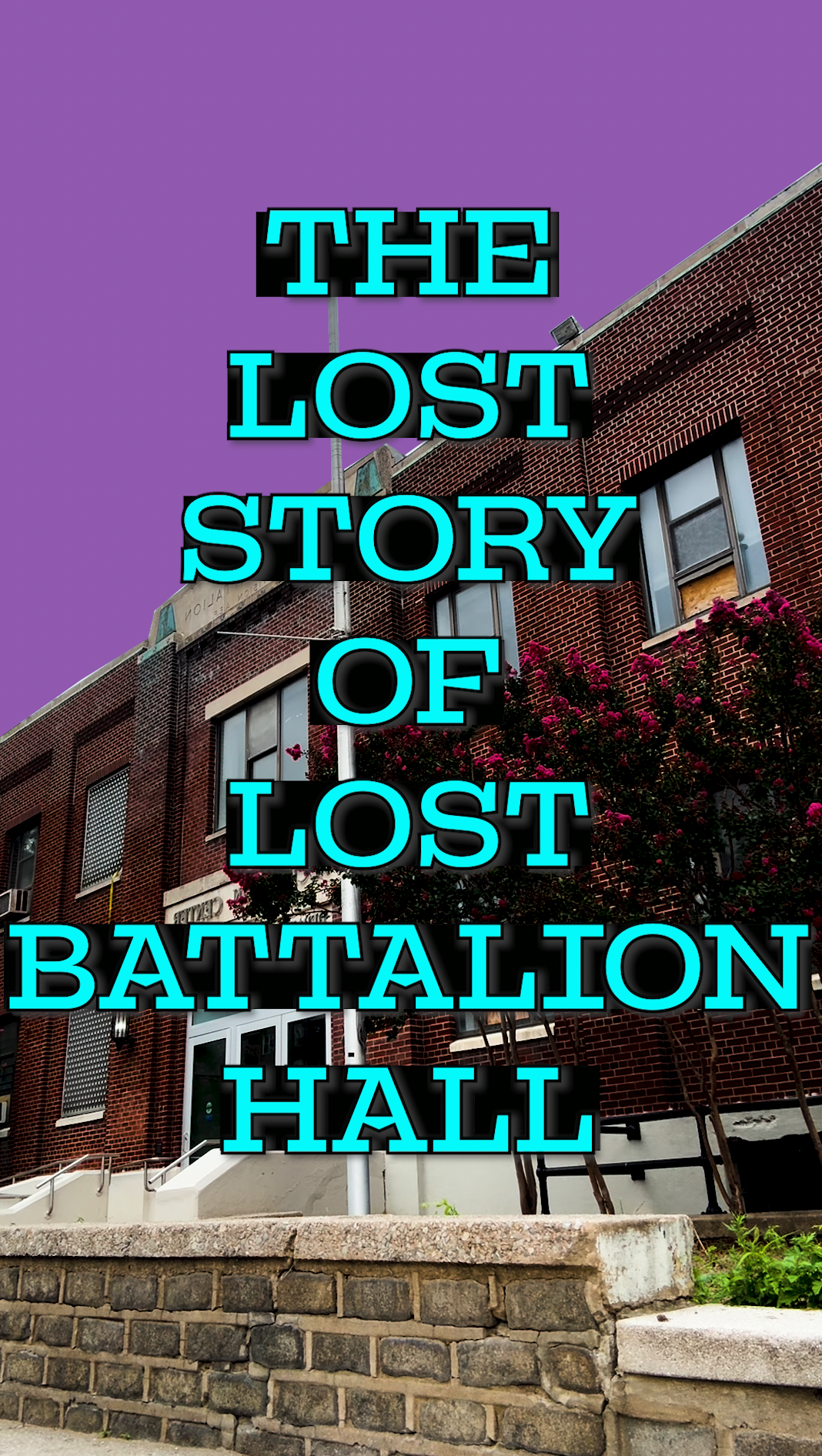
The Lost Story of Lost Battalion Hall
(Script)
INTRO
Making my way down Queens Boulevard, a prewar building in Rego Park kept catching my eye: the Lost Battalion Hall Recreation Center. I wondered why it was called that, and while it underwent a $26 million renovation, I solved that mystery.
I could not find the story on the Internet. The Parks Department website said: This recreation center is named for the heroism of the United States Army’s 77th Division, honoring its service in World War 1.
But that did not explain why that building was named that, or why it housed a military reserve unit and had a firing range and drill room before the Parks Department took it over.
I had a hunch it had to do with George Harvey, Queens’ borough president from 1929 to 1941. I was right but it was more interesting than I had suspected. In any case, a reference to a historical event in 1918 probably doesn’t tell you everything about an artifact from 1938. Something is missing in the narrative. A reference is not a story. The story is lost.
I found the story in the archives at the Queens Public Library—-and as I see it, it’s not really a story about honor, or veterans or World War 1. It’s a story about ego, power and resentment.
LOST BATTALION (NOT THE STORY)
The actual Lost Battalion backstory is interesting I think for symbolic reasons. In the war, Harvey served as a captain in the 77th Division. He received a Distinguished Service Cross for taking out a German machine gun nest. He was also apparently part of the Lost Battalion, a troup that famously got isolated in the Argonne Forest and refused to surrender when surrounded by German Forces. This is still not the story.
HARVEY BACKSTORY PART 1
Even more important, was the city charter. After Consolidation, when New York City became five boroughs, the city adopted a borough government system. The architects of Consolidation wanted to keep the influence of Tammany Hall at bay, so they created borough governments run by borough presidents. These borough presidents had votes in the central Board of Estimate.
When Harvey took over borough hall going into the early ‘30s, he was soon met with a dried up city budget. Queens badly needed money for things like sewers, paved roads and public buildings. It was Harvey’s job to get the money.
Harvey had a vision for a civic center that would house a new courthouse and borough agencies. It would be a physical, percent monument for which he could take credit. But things didn’t go Harvey’s way.
‘HARVEY BACKSTORY PART 2
By the mid-30s, Harvey was at odds with the New Deal administrations at the city and federal levels. At a hearing in 1935, he charged that relief agencies had usurped his powers in overseeing public projects.
It was a time when liberal currents were sweeping the nation, and in Queens, Harvey was at the helm of a right-wing reaction. In 1936, he banned Communists from using the Jamaica Town Hall and tried to have the Communist Party removed from the ballot. x
That year, New Yorkers voted on a City Charter that would curtail the powers of the borough presidents. Harvey said, quote, “When the charter was drawn up, the Communists had a provision placed in it to take away control of public buildings from me.”
At the same time, his civic center dream was falling apart. He’d envisioned it at the Parental School site in Flushing but Jamaica civic groups insisted that the new civil courthouse should be in Jamaica.
And the credit for Queens transformation was going to Rooosevelt, LaGuardia and Robert Moses—
LOST BATTALION STORY
PART 1
—But Harvey had a little window of time before the new charter would go into effect, and had control of a sewer department storage site (or corporation yard) on Queens Boulevard.
In 1937, Harvey had the Works Progress Administation build a community center at the site, with no publicity.
In April 1938, the Long Island Daily Star exposed the project, noting the potential conflict, saying: “There is the question as to whether the building when completed may be placed under the jurisdiction of a city department under the terms of the new City Charter.”
That summer, Harvey announced he had the building built by the Works Progress Adminisrtation with a $400,000 WPA grant, for quote “military and community purposes.” He said he gave a 5-year permit to the U.S. Army’s 77th Division, Reserve Corps, consisting of field infantry regiments, engineers and light tanks.
“The establishment of this division headquarters will give Queens nation-wide importance,” he said, “because it will be the first division headquarters of the Reserve Corps to be established in the country.”
He said the headquarters had a drill hall, a rifle range, a banquet hall, provision for dancing, a bar and permanent caterer, and meeting rooms in the basement for veterans organizations. He said the drill hall would be used for the Boy and Girl Scouts and Junior Naval Militia, and there’d be no athletics.
He said, “The building will be dedicated… in memory of the Lost Battalion of the World War,” adding, “I was commander of that battalion on the British, Chateau-Thiery and Champage fronts in the war.”
PART 2
But it was 1938, and the new charter had gone into effect. City Public Works Commissioner, Edward Markham demanded Harvey surrender the site back to the city.
Harvey replied, “I decline to surrender any jurisdiction whatsoever…”
He told the Star, “If this building was being devoted to the CIO, the American Labor Party or the Communists, there would be no such trouble as we have run into. But it appears that since it is to be given over to the veterans and the Reserve Corps it is a different story.”
He said, “Before surrendering the jurisdiction as requested, I will start a fight in the Supreme Court. I will fill up the building with old sewer pipe and turn it back into a corporation yard.”
Harvey moved forward on the projects, installing a restaurant, bar and cloakroom. He said concessions would be operated by the Queens chapters of the American Legion and Veterans of Foreign Wars, which were actively anti-Communist organizations.
He said if Markham “wants jurisdiction of the building now, he’ll have to conduct his negotiations with the Seventy-seventh Division and the veterans’ groups.”
EPILOGUE
(1939)
On October 5, 1939 a little after World War 2 started, a few thousand people gathered at Lost Battalion Hall, including 26 Lost Battalion survivors.
Search-lights shone on the building, and the Star-Journal wrote, “Something of a martial air pervaded the newly-christened Home of the Lost Battalion on Queens Boulevard.”
A German order to surrender, written on a photostatic copy, was read aloud.
(1960)
In 1960, Lost Battalion Hall was turned over to the Parks Department.